Saturday, 8 October 2011

Day 3 - Workplacement 28/9/11

Time Started - 9:30
Time Finish - 6:30
Total Hours - 9

Self Assessment Report -
Uniform: 4
Punctuality: 5
Initiative: 5
Cooperation: 5
Work Standard: 5
Development of Skills: 5
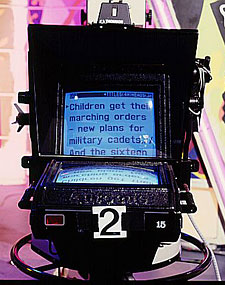
An auto cue similar to the
one in the studio

Today at workplacement I was sent to studio 1 where Kerri-Anne, The today show and the 6pm news is filmed. I get to stay back till 5.30 today so I can watch the 6pm news being filmed. Once again I took the train and the bus to the studio and also walked up the huge hill. In studio 1 I was greeted by the technical director Graeme who is responsible for the maintenance of the auto cue's and all the cameras used mainly their colour and focus. Graeme showed me around the control room and the studio floor where at that time they were filming the end of Kerri-Anne or KAK for short. In the control room there is a long desk up the front of the room where the director, assistant director, switcher, lighting director and technical director sit. Behind them on another desk are the producers. Beside them in a seperate booth is the audio director. Unlike studio 3, studio 1 does not use robotic cameras but rather the cameras are controlled by camera operators. Three cameras are mounted on tripods and two are roaming cameras.
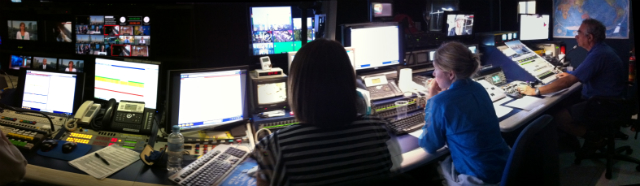
The control room
 During a commercial break Graeme sent me to an outdoor section of the studio were a cooking segment with Alvin from mastercheif was being filmed. Outside there were 2 mobile cameras filming along with the floor manager.  Graeme told me that for large scale demonstrations, the crew film these segments outside in a seperate part of the building such as the bistro or the car park. Upon making my way back to the control room I was fortunate enough to run into Kerri-Anne in the corridor and have a brief conversation with her. She looks so young in the flesh only because she cakes on the make up.
 
Lighitng Desk similar to the
one Stewart uses
Once back in the control room Graeme introduced me to Stewart the lighting director. Stewart is in charge of making lighting plan, all the lights in the studio and he is also responsible for making the host look as good as possible while reducing how much light and glare they are exposed to. Stewart is also responsible for coordinating his two lighting assistants. The lighitng desk that Stewart uses controls the brightness and colour of lights as well as any diming or fading out that needs to be done.


Fresnel Light

Stewart was able to show me the master lighting plan of the studio which had an array of par cans, fresnel lights, soft lights, flood lights and profile lights. He also showed me some specific lighting plots used for different segments that were filmed ie advertorials. These lighting plans show things like behind lights and direct lights. While with Stewart he also showed me a lighting plan he was completing a performance the next day involving a piano.

During a commercial break I was allowed to go onto the studio floor. There I watched the crew film an segment called "ninja nanna" about a 85 year old great grandmother who was learning karate. For this segment a large unfurnished section of the studio was used meaning that news lights had to be used and tested and the position of a couple of cameras had to change. Below is a video of the segment.


The Kerri-Anne Set
Once the filming for the Kerri-Anne show had finished the crew had to set up the studio to film an editorial that would be played in future episodes of Kerri-Anne. The advertorial filmed today was for a rotating hair iron which included 4 models. In order to set up for the advertorial the set used for Kerri-Anne had to be taken down and replaced with a special set specially used for advertorials described as the fluro set. The people reponsible for moving the sets are refered to as stagies who also are responsible for placing props, furniture and aditional visual features such as flowers and vases.

In advertorials the lighting also had to be changed by Stewart and his lighting assistants. On the walls of the studio are various cables used in lighting, audio and vision. The lighting cables connect into inputs on the sets so that they light up and can be used as backlights. Safety with the lighting cables is full maintained with bumps being put over cables that run through pathways. The cables are also coiled in a figure 8 style and duc taped down to the floor.

The actual lights on the ceiling have to be manually moved by Stewart and the lighting assisants making it the hardest and most time consuming process. The process was made especially more long as the set kept changing. At first there set comprised of a glass table and 5 seats, two for the hosts and 3 for the models as that is the standard set used in advertorials. Stewart and his lighting assistants used a long reaching pole to adjust the lights by tilting them, focusing them and adjusting the windows so that the lights did not reflect off the glass, the light matched the skin tone of the host and there wasn't too much glare in the hosts eyes. To test the lights a touch screen panel was used to turn specific lights on and off and control how bright the lights are. A volt reader was also used to read how much light was being exposed to one section of the set. It is used by holding it up behind a persons face, pointed towards the light and pressing a button to get the reading. The lights had to be perfect which is why the process took so long.

But as soon as the client arrived at the studio they decided they wanted the set changed to allow movement and space. Instead the table was taken out and a level was used to seperate the hosts and the the models. The lights once again had to be changed. While the lights were being changed I was lucky enough to be able to talk to the assistant audio technician called Dan. Dan told me about his jobs as an audio assistant and also how he got to that stage in his career. As an audio assistant Dan is responsible for setting up all audio equipment and also for microphones on the studio floor and any problems that may occur mainly with the clip on microphones. Dan said that most of these problems mainly come from the cable, pack or earpiece. He also told me that the ideal position for placing a microphone on a person is in the middle of the chest in front of any jewelrey or fastenings on clothing. All the mcirophones used various people also need to be at the same height so the volume is balanced. Dan's careers path was very different to Jason's as he started out studing physics and the theory behind sound and then did a coarse specially designed for audio in multimedia.

Once filming for the advertorial began Dan gave me a communication radio so I could listen into the conversations between the stage manager, director, camera operators, sound crew and audio assistant. Most of the things discusssed included angles, switching cameras and count downs. On the studio floor the stage manager was responsible for cueing in the hosts. The advertorial overall took a very very long time to film due to how complex the product was and how perfect the client wanted the advertorial. The importance of customer service as really stressed today. Filming for the advertorial lasted until 2.30 so after it was done I went to lunch. Below is another advertorial shot by someone else for the product.


One of the Huge TV's
After I came back from lunch the production were finishing up filming a shoot of just the product alone. After this set up began for the 6pm news with once again the sets and lights being changed. While the studio was being set up I was put into the hands of Graemes 3.00 replacement, William. While it was quiet William let me have a play with the color and brightness effects of the cameras. For basic light and dark all you have to do is move the joystick known as an iris.The colors are split into six different knobs 3 for the white settigns of red, green and blue and 3 for the black settings of also red, green and blue. Out of all the colors green has the greatest effect on the picture. The main point of the colors is to adjust the vision compared to skin tones. One of the other things William is in charge of is the huge TV's that have images played on them during broadcasts such as a harbor backdrop or the weather.

While there was time to spare I went into the audio booth and had a talk with the audio director Bill and audio assitant Jason who I meet on Monday. Bill briefly explained to me how the audio mixing desk worked. Unlike the one in studio 3 the desk is digital meaning that ant eq manipulation can be seen on a screen. But like the desk in studio 3 sound effects and music are part of the audio job. The music and sound effects are controlled through a touch panel and are played on cue from the director. The music that is picked to be played during a show is picked by the executive and usually matches the scene being filmed. Accroding to Bill it is the nicest mixing desk in the complex. Jason's job as the assistant was very similar to Dan's being he was resonsible for the microphones.

Peter Overton
Before filming for the news began a promo was recorded to be played during a commercial. While doing the first take the audio became very bouncey due to how hard the set was, so the promo had to be recorded again. The news host for tonights broadcast was Peter Overton. Because of his low voice the eq in audio had to be adjusted quite a bit. During the broadcast there were no serious problems in audio or lighting but there was a bit of a problem with the vision during the weather as the graphics were out of sync with the autocue. Beside this the broadcast was a success and the news was quite enjoyable to watch. Tommorow I'm hoping to see a lot in news edit.

Thursday, 6 October 2011

Day 2 - Workplacement 27/9/11

Time Started - 9:30
Time Finish - 5:30
Total Hours - 8

Self Assessment Report -
Uniform: 5
Punctuality: 5
Initiative: 4
Cooperation: 4
Work Standard: 4
Development of Skills: 4

Today was my second day of workplacement at channel 9. Once agin like yesturday I took the train then the bus to Willoughby and once again walked up the really steep hill to the studio. Today I was in the on air tapes section of the complex or the place where the commercials are inserted into the gaps between programs. As well as providing channel 9 Sydney with commercials they also provide commercials for Channel 9 Melbourne, Go in Sydney, Brsibane, Melbourne and Darwin and Gem in Sydney, Melbourne and Brisbane. All the commercials are put together in different studios because different states require different commercials.

My day in on air tapes began in Channel 9 Sydney with Stuart. When I got there there wasn't much to do as it was a very unbusy time of day, it would not be until prime time that it would get busy. Stuart like many of the other employees in the studios communicated using communication boxes. Stuart also used emails to communicate with others in the complex mainly about complaints from manufactures about their commercials going to air. One of these complaints came from a company called marble works who claimed that their ad had not been played. Stuart then checked the tape with the commercial in its line up to see if it had actually been played. Another incident Stuart had to deal with was a complaint from Just Jeans. The manufacturer stated that the blues in the jeans were too dark so they sent another tape to Stuart with the correct colouring. Stuart concluded that the colours may of faded due to how the commerical had been downloaded from the ineternet which is how most ads are obtained. Below is the ad that was complained about.


After a couple of hours with Stuart I was then sent to the Go office where the commercials were put together for Sydney, Brisbane, Melbourne and Darwin. The man I was working with showed me the ad cue were the commercials are cued and listed with their durations next to them. He also infiormed that each ad must have a specific time limit of either 15, 30, 45 or 60 seconds in order to be put into the cue for 3 minutes. Also listed in the ad cue was the graphics that appear on screen during the program like ratings, the channel 9 logo anf promos. He also told me that ads that were cued but not ready in time to be broadcast were replaced with promos and community service announcements. What I noticed when watching all the various state channels going at once was that the program being played was the same but the ads were different yet still ran for the same amount of time. For go in Sydney and Melbourne there were back up networks that could be swapped to manually incase there was a problem with the current network. After a couple of hours in Go I was sent to lunch.

After lunch I went back to Channel 9 Sydney with Stuart. After an hour stuart was replaced by Kate. Kate showed me exactly how tapes are brought to the studio and cut in order to be played on air. Each commercial would begin with a 10 seond count down. From the first vision that appers Kate would have to fast forward two frames usng a analog stick then cut the video using a computer. The tape would then be ejected at put into a large storage system witht the capasity to hold 1000 tapes. While with Kate during prime time I witnessed her taping all the A Current Affair and news promos recorded in studio 3. I also saw Kate looking through and checking what was called black board ads, the promos that say "brought to you by".

Also in the studio behind where Kate was working was a man who checks all the imported programs that were to air that night like two and a half me and charles angels. The man would have to check for things like graphics and subtitles. With these tapes with the actucal program there would also be a back up tape in case there was a problem with the original.

The tapes used by bothe Kate and the man are able to hold up to 20 commercials on them and are blacked out after use and reused  for other commercials. When I say that tapes are being used I mean VHS video tapes. When I first arrived in on air tapes I did not expect there to be such old technology used but rather DVD's or digital technology. While discussing this with Stuart he told me that within 5 years times there would be a new on air tapes studio opening in Frenches Forest which would be entirely digital. Overall today my work experience was not very eventful but I am excited to be working in studio 1 tommorow.

Day 1 - Workplacement 26/9/11

 
Time Started - 9:30
Time Finish - 5:30
Total Hours - 8

Self Assessment Report -
Uniform: 5
Punctuality: 5
Initiative: 4
Cooperation: 4
Work Standard: 5
Development of Skills: 5

The front entrance to the studio.
Today was my first day of work experience at tcn channel 9. Dressed in my smart casual clothing my day began with a train trip to Wynyard, then a bus ride to Willoughby and finally a walk up a very very steep hill to the channel 9 studios. Also doing work experience was Eric, as part of his TAFE course. At 9.30 I was greeted by technical director Marco Snickers and given my pass which allowed me access to the studio every day for the rest of the week.
Before my work placement commenced I was given a tour of the complex. I was taken level 3 of the building were the news edit rooms rooms were and also studio 3 was were A Current Affair and the 11am and 4.30pm news was filmed. Next I was taken to level 2 of the building were the on air tapes office was (the place were the commercials are played), were the audio booths where, were network connections was and most importantly were all the wires and technical cables were stored. Finally I was taken to the ground level of the building where the engineering office was, were I was to be today, to studio 1 were shows like kerri-anne and the 6pm news was filmed and finally I was taken to studio 2, the biggest studio in the complex used to record the footy show, the Sunday footy show and funnist home videos and other shows with live audiences. While in studio 2 I noticed the wide range of lights used hanging from the ceiling including par cans, profile spots, intelligent lights and fresnels. While in studio 2 I was also shown the audio mixing booth that still used a functional 25 year old mixing desk. 
The Cable Tester

Following my tour I was sent to my engineering to commence my work placement. Engineering is very similar to techincal or ICT support as they fix any problems with mixing desks, televisions or other devices. The engineers also make various wire connectors using crimpers and various screws and bolts. While in engineering I witnessed engineer Alex test the cable connection in fader 7 on the audio mixer in studio 1. Alex used a cable tester very similar to the one we have at school. The problem was not with the cables but with what setting the audio technicaian had the mixing desk on. After that problem was fixed I went with Alex to replace a television on level 4 of the building where the executives offices were. Alex told me that they mainly used LG tv's as they are cheap and work very well. After this I was sent to lunch.

Once I came back from lunch Marco sent me to the network cables/ connections office which can basically be described as the control centre for outside material from other connections eg Melbourne, London and LA. As well as this newtwork connections also deals with the frequencies and transmission signals used in live broadcasts. What I found interesting about network connections was how with the flick of a button you could talk to someone in LA. While in network connections I also noticed the first of many communication channel boxes. Most of the studios and offices have these boxes to communicate with all parts of the building. By flicking one of the buttons on a channel down you can communicate with that person in the channel and by flicking it up you can listen to what the other person is saying in the channel. 
Examples of Robotic cameras

Auto cue
After three hours in network connections I was sent to studio 3 for the filming of the 4.30 news with Wendy Kingston. What amazed me most about studio 3 was the cameras. Unlike studio 2 and 1 the cameras are not manouvered by camera operators but the cameras are robotic, controlled by the technical director. Along with the robotic cameras auto cue machines were also widely used in the studio. The autocue machines were actually cameras that reflected text into the cameras lens so that a host can look directly into the camera while saying their script. What also amazed me was the glass window behind the presenters in the studio which displayed the news edit room behind the window. Marco described the mirror as being the most expensive piece of equipment in the building as it is darkly tinted, blurred and placed on a 16* angle to ensure that the lights in the studio don't reflect off or through the screen.

A clip on microphone similar to the
 one Jason showed me
While in the studio I was lucky enough to talk to the audio technician, Jason. Jason showed me the audio mixer and the clip on microphones used on the hosts. These microphones were described as very fine microphones with two cables that feed into an XLR connector that goes into a patch bay on the news desk then into the audio mixer. As an audio technican, Jason is also responsible for the various music and sound effects described by the director as a sting. While waiting around for the news to start I talked to Jason about how he became an audio technician. He told me how he started out as a music producer in year 11 then fell into tv as the music industry detereorated. As I am interested in the music and audio industries Jason told me that employers look for people with engineering degrees from universities such as JMC and SAE.
My pass to get in.
Before the live filming commenced Jason did a line check with Wendy Kingston the host and also various reporters in locations outside the studio. The live broadcast began with a count down from 10 to start the program. After this Jason cued the opening music and voice over. Throughout various times in the program Jason controlled the volume and eq of the various presenters and also the sound effects present in the show including various wosshes and musical sounds. The broadcast however was not without its faults. At one time in the broadcast Jason was too late in turning up the volume of a guests microphone so briefly there was silence. Also a signal was lost during the broadcast so a section of the bulliten was cut short. Aside from these faults the braodcast was good to watch and interesting. After the broadcast I was done for the day.

Monday, 26 September 2011

Pre Workplacement: 24-25 Septeber


From the 26th to the 30th of September I will be undertaking workplacement at The Channel 9 Studios in Willoughby.  During my placement I will be assisting the audio crew with the set up and operation of various TV shows. I will be working from 9.30-5.30. The dress code for my placement is smart or neat casual and closed footwear needs to be worn.

Before my placement I was sent an email from Marco Sneikers the technical planning manager at 9. The email contanied my roster, welcome letter, confidentiality letter, placement record, questionaire and induction powerpoint.
My Roster
Transport: To get two and from my work placement I will be taking a train from Concord West station to Wynyard then from there I will be taking a bus (M40) to the channel 9 studios. I hope to gain a lot of knowledge from this experience.


Sunday, 25 September 2011

First Aid 16/9/11

On Friday the 16th of September the Entertainment, Hospitality and PDHPE classes participated in the senior first aid coarse offered by the college. The coarse was run by the Royal Life Saving Society of Australia.

 Before the coarse began we had to read a coarse book given to us by our teachers and also completet a comprehension book that accompanied the coarse book. In order to get our certificate we would need to finish the comprehension book.

During our coarse our instructors went over various things with us including what first aid is, legal obligations, cpr, shock, bandages, pressure imobalisation technique and practical first aid. To learn about these things our instructors put us through various practical tests including CPR using a dummy or "Little Anne", bandaging members of the class and practical First Aid Testing.


At the end of our coarse we were all had to sit an exam to gain our certificate. No one failed the test so we all gained our certificate. Overall the day was very enjoyable and informative and this certificate will hopefully benefit me in the future. 

Tuesday, 20 September 2011

My New Effects Pedal

For my Birthday I got given a Boss ME-20B Bass Guitar Multi Effects Pedal. My mum bought it from Billy Hyde's in Parramatta for $253.00. It has many different effects for use in performances that can be blended together and also saved for quick reference. These effects include:

Special Effects: T.wah up, T. wah down, T. wah edge, defretter and octave
Compressor/Drive: Compressor, overdrive, distortion, OD+direct, synth 1, synth 2
Delay/modulation: 0-99ms delay, 100-700ms delay, phaser, flanger, chorus, cho+delay, reverb.

Along with these effects there is also an equalizer, noise suppressor, bass enhance, wah, foot volume and master level controls. The coolest thing for me about the pedal is the wah pedal as it allows me to add tone to some songs that sound better with a wah pedal.


Here are some reviews:
http://multieffectspedals.guitarsphere.com/bass-multi-effects-pedal-boss-me20b/
http://www.musiciansfriend.com/bass/boss-me-20b-bass-multi-effects-pedal


Monday, 19 September 2011

Hunters Hill XFactor 16/9/11

On Friday the 16th of September myself and various other performing arts students performed at and attended the Hunters Hill X Factor performance held at the Hunters Hill Town Hall. The show was a great chance for students to show off their skills as performers to a team of judges. The show was run at a very professional level.

There were various people with professional standard jobs working at the show including a stage manager, audio technician, lighting technician and backstage crew. In rehearsals they gave all the performers run downs of what was happening in the show and what was expected of us backstage.

At the venue the first thing you notice when you walk in is huge lighting rig across the front of the stage. The rig was equipped with intelligent lights and par cans and their was also a projector above the stage that projected designs onto the back wall of the stage. At the very back of the hall there was also a follow spot light set up being run by students.


There was a huge audio system as well set up around the stage behind the lighting rig with speakers sitting either side of the stage. The audio system was used to play backing tracks for singers and also for wireless microphones, amplifiers and the DJ system set up on the side of the stage. 


In terms of vision systems there was a projector set up on the side of the stage to broadcast the show to the audience members sitting at the back of the hall. The quality of this was very poor though.

During the show all the performers were sat in front of the stage ready to be ushered off by the stage manager backstage. When backstage there was a dressing room for performers and also a storage area for instrument cases. on stage my band and myself used a wireless microphone, a bass amp, guitar amp and a drum kit mounted on a rostrum with wheels attached to the bottom. Before we began there was a issue with audio systems as one of the dancers from the previous act had pulled out a cable in the audio system.

The show overall was very enjoyable and of a very high professional quality.